

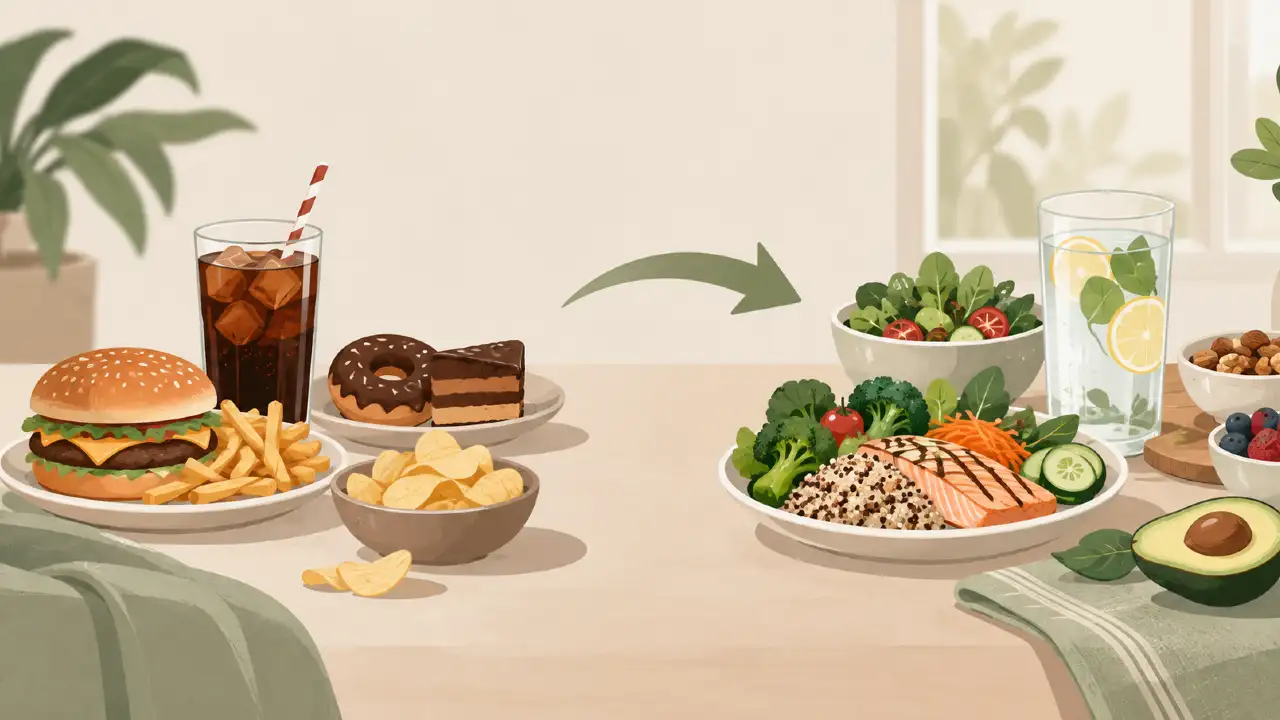
You eat reasonably well. You’re not a big drinker. Your last checkup was fine. And yet you’re tired more often than you’d like to admit, and somewhere in the back of your mind you wonder if something is quietly going on that nobody’s mentioned yet.
Your liver could be under real strain right now, and you might not know it. Not because it’s being dramatic. Because it genuinely can’t tell you through pain.
In short: the liver has no pain receptors, so everyday habits — regular sugary drinks and fruit juice, fried and ultra-processed food, refined carbs, and heavy alcohol use — can quietly build up fat and strain in the liver for years with no symptoms at all. Swapping these for whole foods, water, and whole grains — and limiting or avoiding alcohol based on your own liver health — is what actually protects it. Early fat buildup in the liver is often reversible once those habits change.
Why this matters more than most people realize
Around 3 in 10 adults worldwide are now living with a condition called metabolic dysfunction–associated steatotic liver disease, or MASLD (you may have seen it under its older name, NAFLD, non-alcoholic fatty liver disease — the international nomenclature was updated in 2023 to better reflect what’s actually driving it) [1, 2]. That’s not a rare condition affecting a small unlucky group. That’s roughly the person next to you on the bus.
Most people with early-stage MASLD have completely normal-feeling bodies. No pain, no obvious signs. It’s often found by accident, on a scan or blood test done for something else entirely.
That gap — between what’s happening inside the liver and what you can actually feel — is the whole story of this article.
Why the liver stays quiet about it
The liver is a large organ involved in hundreds of essential jobs at once [14]: processing what you eat and drink, managing blood sugar, clearing waste, making the proteins your blood needs to clot properly. It does almost all of this without asking for credit.
Here’s the part people often miss: the tissue of the liver itself has no pain receptors. None. You could (in theory, not that anyone should try) press directly on liver tissue and it wouldn’t register as pain.
What can hurt is the thin, fibrous lining wrapped around the liver, called Glisson’s capsule. That capsule does have nerve endings. So pain only shows up once the liver has swollen enough — usually from fat buildup or inflammation — to stretch that outer lining. By the time you feel that dull ache under your right ribs, the liver has often already been under strain for a long time.
So what actually causes that strain in the first place? Mostly, it comes down to what’s arriving in the liver more often than it can comfortably process.
The sugar connection, explained simply
The short version, without the jargon: when you eat sugar — especially in liquid form, like soda, sweetened coffee drinks, or fruit juice — a good portion of it goes straight to the liver to be processed. Unlike glucose, fructose is metabolized almost entirely by the liver and doesn’t require insulin to enter liver cells, allowing larger amounts to be processed there directly.
Once there, a portion of that fructose gets converted into fat through a process researchers call de novo lipogenesis — literally, “making new fat from scratch.” Do this often enough, and that fat can start accumulating inside liver cells rather than being used or cleared normally [3].
This is the same basic mechanism, at a smaller and more chronic scale, whether the source is a can of soda, a “healthy” bottled smoothie, or a daily glass of fruit juice. The fruit itself isn’t the problem — the fiber in whole fruit slows this whole process down [16]. It’s concentrated, fiber-free sugar, consumed often, that adds up.
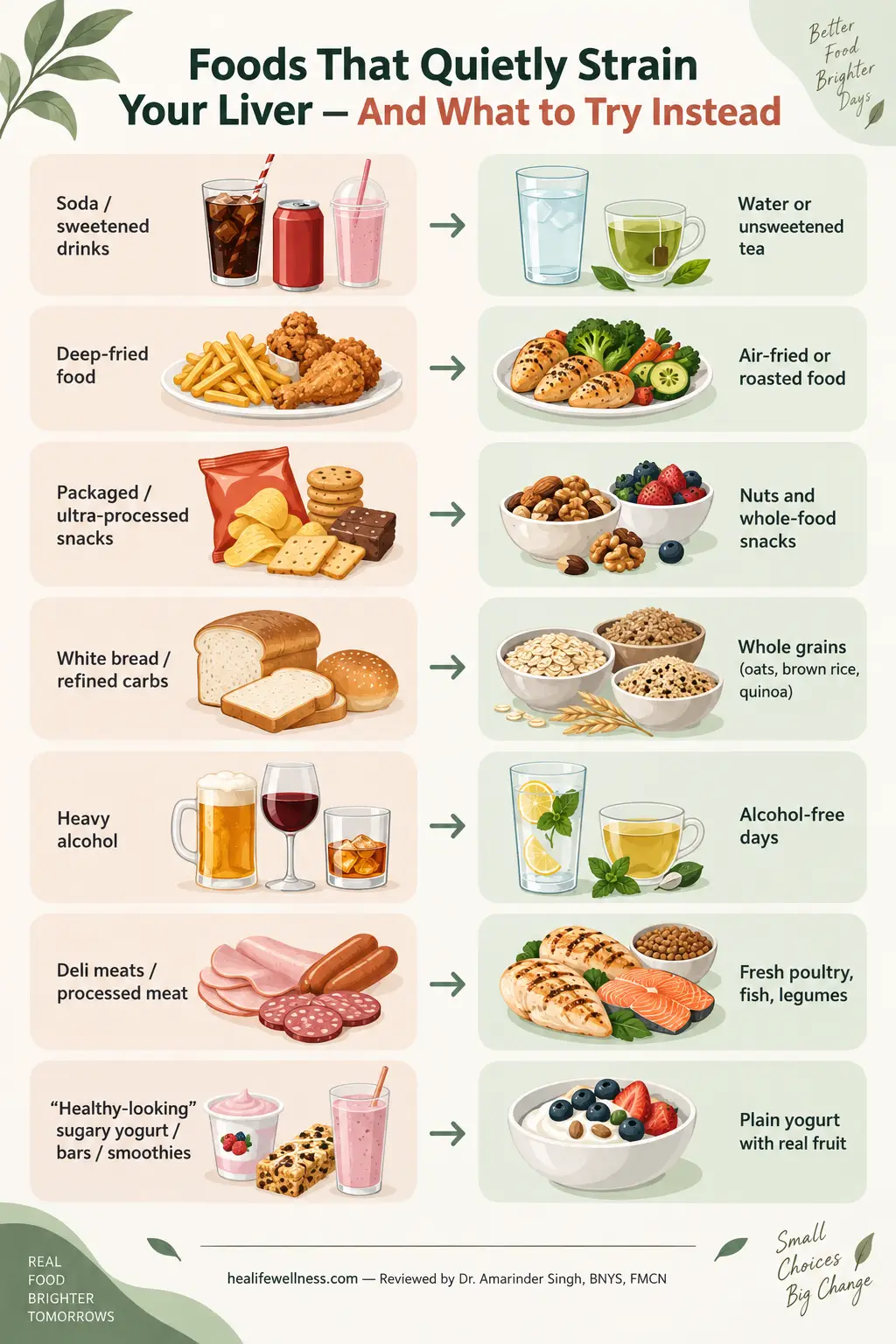
Foods that quietly strain the liver — and what to eat instead
This is less about any single “bad” food and more about pattern. Occasional treats are not the issue. Daily, default habits are.
| Instead of this | Why it strains the liver | Try this instead |
|---|---|---|
| Soda, energy drinks, bottled fruit juice, sweetened coffee drinks | Concentrated, fiber-free sugar drives fat production directly in liver cells (de novo lipogenesis) | Water, sparkling water with citrus, unsweetened tea, or whole fruit instead of juice |
| Deep-fried food (fries, fried chicken, samosas, pakoras) | Frequent frying is part of the broader ultra-processed, high-fat eating pattern linked to fat buildup in the liver [13] | Air-fried, roasted, or pan-cooked versions using a stable oil like olive or avocado oil |
| Packaged snacks, instant noodles, most ultra-processed foods | Combines refined starch, added sugar, unhealthy fats, and heavy additive load in one product | Nuts, roasted chickpeas, fruit with nut butter, or home-cooked leftovers |
| White bread, pastries, refined white rice and pasta on a daily basis | Refined carbs digest fast and spike blood sugar, pushing the liver toward the same fat-storage pathway as sugar | Whole grains — oats, brown rice, whole wheat, quinoa — which slow that spike down |
| Regular or heavy alcohol intake | The liver prioritizes processing alcohol over almost everything else; regular heavy use is linked to direct liver cell damage over time [13] | If you drink, ask your clinician what’s right for you — and build in regular alcohol-free days either way |
| Frequent deli meats and heavily salted processed meat | Common source of excess sodium, and usually eaten as part of the same processed-food pattern linked to liver strain | Fresh poultry, fish, eggs, or legumes as your everyday protein |
| “Healthy-looking” sugar traps — flavored yogurt, granola and protein bars, bottled smoothies | Often carry as much added sugar as a dessert, just marketed differently | Plain yogurt with your own fruit, whole-food snacks, homemade smoothies where you control the sugar |
A smaller but real one: moldy nuts and grains. Peanuts, corn, and some tree nuts can carry a mold-produced toxin called aflatoxin when they’ve been stored damp or gone past their prime. Regular exposure is linked to liver damage and, over time, higher liver cancer risk [5, 6]. Worth knowing: aflatoxin itself is usually invisible, odorless, and tasteless, so appearance alone isn’t a reliable way to check for it. Discarding anything visibly shriveled, discolored, or off still helps, but the more reliable safeguard is buying from established brands that test for it and storing nuts and grains somewhere cool and dry.
This doesn’t mean these foods can never be eaten again. It means they shouldn’t be the default, every-day base of what you eat.
Who should pay closer attention
This pattern doesn’t affect everyone equally. A few groups are worth flagging, not to worry anyone, but because for these people, the food pattern above stops being a “nice to have” and becomes genuinely worth prioritizing:
- People carrying extra weight, especially around the abdomen
- People with type 2 diabetes or prediabetes — research suggests up to 7 in 10 people with type 2 diabetes have some degree of MASLD [7]
- People with high triglycerides, high LDL cholesterol, or high blood pressure
- People with polycystic ovary syndrome (PCOS), sleep apnea, or an underactive thyroid
- People with a family history of liver disease
Worth saying plainly: some people develop MASLD without any of these risk factors, and genetics plays a real role too. None of this is about blame. It’s about knowing where your own attention is best spent.
Beyond food: what else your liver is reacting to
The mechanism explained earlier — sugar and insulin driving fat production inside liver cells — doesn’t only respond to what’s on your plate. A few other everyday factors feed into that exact same pathway.
Movement changes how that fat gets used. Physical activity improves how well your cells respond to insulin, which is directly tied to the fat-storage pathway described earlier — regular movement can improve insulin sensitivity and help reduce liver fat [15]. This doesn’t require intensity. Consistency is what matters here.
Sleep runs on the same clock your liver does. Fat storage in the liver follows its own daily rhythm, tied to your body’s internal clock. In people with fatty liver disease, shorter sleep, poorer sleep quality, and late-night eating have been associated with higher liver enzymes and greater insulin resistance in research studies — not just tiredness the next day [12]. Good sleep is therefore another part of the broader metabolic picture this article has been describing.
Two things add load without adding food. Smoking has been associated, independent of diet, with faster progression of liver fibrosis — the process of scarring that can follow long-term liver strain — through some of the same insulin-resistance and inflammation pathways already at work in fatty liver disease [11]. And regular alcohol-free days are a practical way to reduce your overall alcohol exposure, which matters because alcohol can add to liver injury — particularly for anyone who already has liver disease.
This works the same way the food pattern does — small, repeated, and boring in the best sense.
What a liver-friendly day actually looks like
Not a meal plan, just a shape you can borrow and adapt:
Morning: Water or unsweetened tea instead of a sugary coffee drink. Something like oats with fruit and a few nuts, rather than a pastry or sweetened cereal.
Midday: A plate built mostly around vegetables, with a portion of protein (fish, eggs, legumes, or poultry) and a whole grain — brown rice, whole wheat, or quinoa — rather than refined white versions.
Afternoon: A piece of whole fruit or a small handful of nuts, instead of a packaged bar or bottled smoothie. Water instead of a soda.
Evening: A home-cooked meal using olive oil rather than a fried takeout order, ideally not too late or too heavy. A short walk afterward, if that fits your day.
That’s it. No numbers to hit, no foods that are permanently off-limits — just a default pattern that, repeated most days, is doing your liver a real favor.
A caution about “liver detox” products
You’ll come across a lot of products marketed as a liver detox or cleanse. Worth knowing upfront: your liver already does this job, continuously, on its own. There’s no good evidence that a tea, powder, or supplement helps it “flush out” anything faster.
More importantly, some of these products can work against you. Liver injury caused by herbal and dietary supplements is a real, well-documented, and growing category in the medical literature — including a published case of liver injury caused directly by an over-the-counter herbal “liver detox” tea [9, 10]. High-dose vitamin A, kava, comfrey, and concentrated green tea extract are among the substances that show up repeatedly in these case reports.
This isn’t a reason to avoid supplements altogether. It’s a reason to be skeptical of anything promising a fast cleanse, and to mention any supplement you take regularly to your doctor — especially if you’re also managing a health condition.
When it’s more than a food question
Most of the time, the fix here is genuinely about steady, boring, repeatable habits — not a crisis. But a few signs are worth taking seriously enough to see a doctor rather than adjusting your diet and hoping:
- Fatigue that doesn’t improve with rest, especially if it’s new or worsening
- A dull ache, fullness, or discomfort under your right ribs
- Yellowing of the skin or the whites of your eyes (jaundice)
- Unusually dark urine or pale stools
- Unexplained swelling in the abdomen or legs
- Persistent itchy skin with no obvious cause
- Unexplained, unintentional weight loss
If any of these show up, that’s a conversation for your doctor, not something to try to self-manage through diet alone. If your doctor wants to look closer, it usually starts simply: a blood test — sometimes called a liver panel — that checks liver enzymes like ALT and AST. These reflect stress on liver cells, not a full picture of liver function on their own. Depending on what that shows, your doctor might follow up with an ultrasound or a liver stiffness test (often known by the brand name FibroScan). None of this is invasive. What gets ordered depends on your own history, not a fixed annual routine. And the earlier this is caught, generally, the more responsive it is to change — though more advanced stages need active medical management rather than diet alone.
FAQ
Can the liver actually heal itself?
Yes, to a meaningful degree. The liver is one of the few organs in the body that can regenerate, and early fat buildup — before it progresses to scarring — is often reversible once the underlying diet and lifestyle pattern changes. This isn’t a guarantee for every stage of liver disease, but for the early, common pattern this article covers, the outlook is genuinely encouraging.
Is fruit bad for the liver?
No — whole fruit is not the same as fruit juice. The fiber in whole fruit slows down sugar absorption, which changes how the liver handles it [16]. Juice removes that fiber and concentrates the sugar, which is the part worth limiting, not fruit itself.
Are eggs good for the liver?
Yes, in moderation. Eggs provide protein and choline, a nutrient the liver needs for normal function [17], making them a reasonable everyday protein choice.
Does coffee help liver health?
Likely yes, for most people. Several studies link regular coffee intake to lower rates of liver disease progression, though the exact reason isn’t fully settled — a reasonable “keep doing this if you already enjoy it” rather than a reason to start.
Do liver detox or cleanse supplements actually work?
No — there’s no good evidence they speed up what your liver already does on its own, and some have been linked to documented cases of liver injury instead. If you want to support your liver, the food pattern and habits in this article have far stronger evidence behind them than any detox product does.
What’s the fastest way to support my liver through diet?
Reduce added sugar and ultra-processed food, build meals around vegetables, whole grains, lean protein, and healthy fats, and ask your clinician whether you should limit or avoid alcohol. There’s no real shortcut here — sustained, ordinary changes are what the evidence actually supports.
What are the earliest signs of a liver under strain?
Often, there are none at all, since the liver has no pain receptors of its own. When symptoms do appear, they can be nonspecific, such as fatigue or discomfort in the upper-right abdomen.
This article is for general education and reflects general food-pattern guidance rather than a treatment plan for diagnosed liver disease — your needs may differ if you have a diagnosed liver or metabolic condition, or another medical condition that affects your dietary needs. It does not replace personalized medical advice and is not intended to diagnose, treat, or replace a consultation with a qualified healthcare professional. If you have concerns about your liver health, please speak with your doctor.
Disclosure: The author has no relevant financial relationships or commercial affiliations related to the content of this article.
References
- Rinella, M.E. et al. “A multisociety Delphi consensus statement on new fatty liver disease nomenclature.” Hepatology, 2023.
- “From NAFLD to MASLD: updated naming and diagnosis criteria for fatty liver disease.” Journal of Lipid Research, published online December 14, 2023; print issue Vol. 65, January 2024.
- Jegatheesan, P. & De Bandt, J-P. “Fructose and NAFLD: The Multifaceted Aspects of Fructose Metabolism.” Nutrients, 2017.
- WebMD. “What Does Liver Pain Feel Like?” (liver capsule / pain receptor mechanism)
- National Cancer Institute. “Aflatoxins.” cancer.gov
- U.S. FDA. “Mycotoxins.” fda.gov
- Mayo Clinic. “Nonalcoholic Fatty Liver Disease (MASLD) — Symptoms & Causes.”
- Johns Hopkins Medicine. “Nonalcoholic Fatty Liver Disease.”
- Gudushauri, N., Navarro, V.J., Halegoua-De Marzio, D. “A comprehensive update in herbal and dietary supplement–induced liver injury.” Clinical Liver Disease, 2024.
- Niazi, B. et al. “Drug-Induced Liver Injury from Herbal Liver Detoxification Tea.” Case Reports in Gastroenterology, 2022.
- Xu, J. et al. “Cigarette Smoke Contributes to the Progression of MASLD: From the Molecular Mechanisms to Therapy.” Cells, 2025.
- Bernsmeier, C. et al. “Sleep Disruption and Daytime Sleepiness Correlating with Disease Severity and Insulin Resistance in Non-Alcoholic Fatty Liver Disease.” PLoS ONE, 2015.
- EASL-EASD-EASO. “Clinical Practice Guidelines on the Management of Metabolic Dysfunction-Associated Steatotic Liver Disease (MASLD).”
- Johns Hopkins Medicine. “Liver: Anatomy and Functions.”
- “Structured Exercise Interventions and Hepatic-Metabolic Outcomes in Adults with MASLD: A Narrative Review of Randomized Controlled Trials.” International Journal of Molecular Sciences, 2026.
- Alkutbe, R. et al. “Nutrient Extraction Lowers Postprandial Glucose Response of Fruit in Adults with Obesity as well as Healthy Weight Adults.” Nutrients, 2020.
- NIH Office of Dietary Supplements. “Choline — Consumer.” Fact sheet.